

It's All Training: A Fully Synthetic Single-Stage Recipe for LLMs
Paper • 2609.37891 • Published

Paper (NeurIPS 2026) · SYNTH dataset · Baguettotron-350M · Baguettotron-600M
Baguettotron-MoE is a 13B-total / 1B-active Mixture-of-Experts reasoning model trained from scratch on 50B tokens of SYNTH, a fully synthetic corpus amplified from 58,698 Wikipedia articles. It is the sparse member of the Baguettotron suite in our NeurIPS 2026 paper, It's All Training: A Fully Synthetic Single-Stage Recipe for LLMs.
<think> traces and recalls facts because SYNTH trains those capabilities directly.A Mixtral-style sparse decoder with top-1 routing over 16 experts and no shared expert.

| Total parameters | 13.3B |
| Active parameters per token | 1.08B (excl. the 84M input-embedding lookup) |
| Layers | 47 |
| Hidden size | 1280 |
| Attention | GQA, 20 query / 4 KV heads, head dim 64 |
| Experts | 16 routed, top-1, no shared expert |
| Expert MLP | SwiGLU, intermediate size 4480 |
| Router | Softmax, no top-k renormalization |
| Position encoding | RoPE, θ = 10,000 |
| Norm | RMSNorm (pre-norm), ε = 1e-6 |
| Embeddings | Untied |
| Vocabulary | 65,536 (Pleias tokenizer) |
| Context length | 2,048 tokens |
Why trust_remote_code is needed. Stock Mixtral renormalizes the selected router scores to sum to 1, so with top-1 routing every expert output gets weight 1.0. This model was trained with the raw softmax probability of the chosen expert as the gate (typically 0.16–0.5). Loading it as plain Mixtral inflates expert outputs 2–6×. modeling_baguettotron_moe.py overrides only the router and keeps everything else identical to Mixtral.
torchtitan with FSDP (experts sharded through FSDP, no expert parallelism), ~17.5% MFUAll scores are from the paper. Each model is prompted in its native format; Baguettotron models get no system prompt and have <think>\n seeded after the assistant turn.
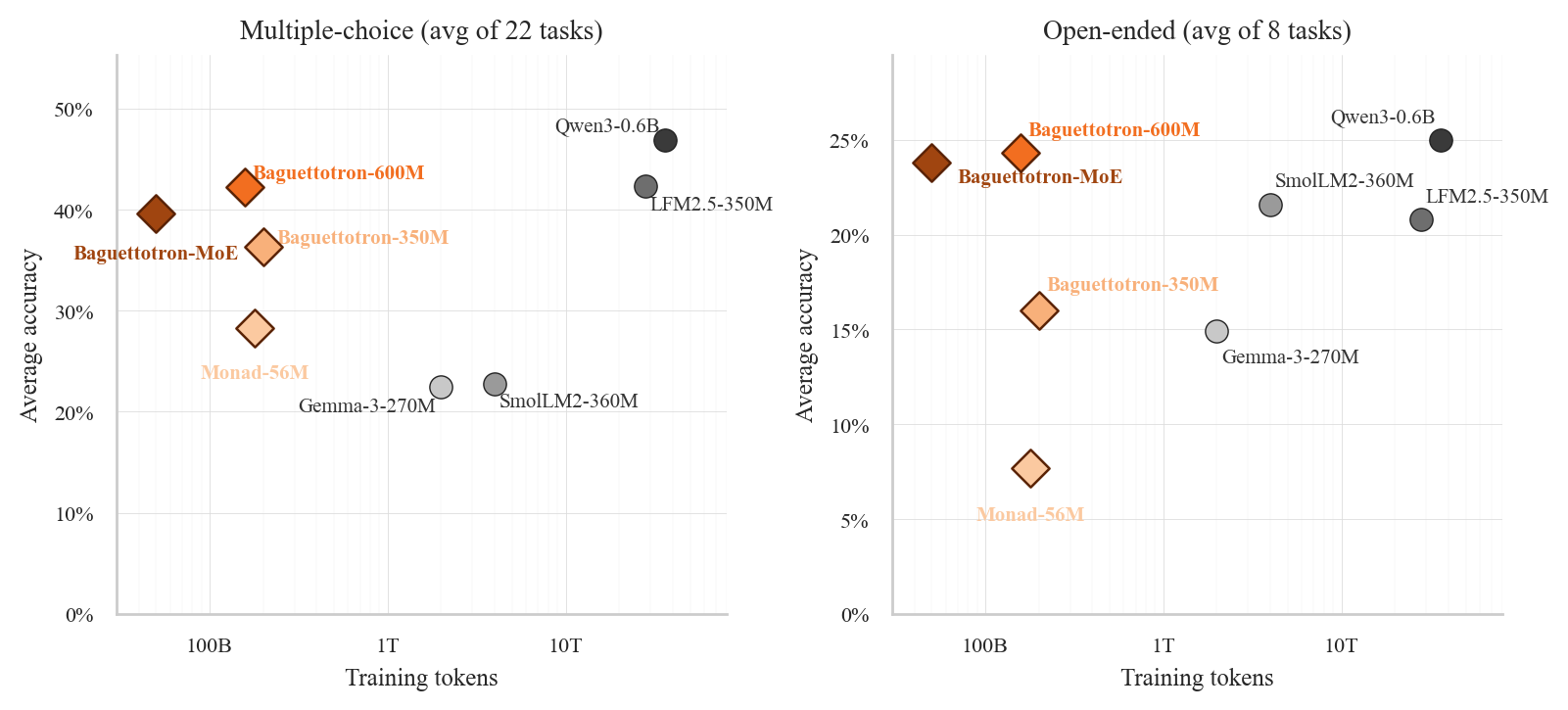
General benchmarks
| Model | Training tokens | MCQ (22 tasks) | Open-ended (8 tasks) |
|---|---|---|---|
| Baguettotron-MoE | 50B | 39.6 | 23.8 |
| Baguettotron-600M | 158B | 42.2 | 24.3 |
| Baguettotron-350M | 200B | 36.3 | 16.0 |
| Qwen3-0.6B | ~36T | 46.9 | 25.0 |
| LFM2.5-350M | 28T | 42.3 | 20.8 |
| SmolLM2-360M-Instruct | 4T | 22.8 | 21.6 |
| Gemma-3-270M-IT | 2T | 22.5 | 14.9 |
Factual precision (FActScore, 500 Wikipedia entities)
| Model | Training tokens | S/(S+C) | Macro |
|---|---|---|---|
| Baguettotron-MoE (13B / 1B active) | 50B | 81.7 | 46.3 |
| DeepSeek-MoE-16B-Chat (16B / 2.8B active) | ~2T | 82.9 | 38.3 |
| OLMoE-1B-7B-Instruct (7B / 1B active) | ~5.1T | 82.6 | 33.4 |
The model was trained on ChatML with a <think> block and no system prompt. The bundled chat template opens the assistant turn with <think>\n:
<|im_start|>user
What do you know about the Treaty of Westphalia?<|im_end|>
<|im_start|>assistant
<think>
The model writes its reasoning, closes it with </think>, answers, and ends the turn with <|im_end|>.
RAG. Pass sources inside the user turn. The answer then cites them with <ref>[quote]</ref>:
<|im_start|>user
{question}

<source_1>[…]</source_1>
<source_2>[…]</source_2><|im_end|>
<|im_start|>assistant
<think>
Reasoning notation. Traces use SYNTH's compact stenographic style (→ derivation, ↺ backtracking, ∴ conclusion, …). The confidence markers ● (high), ◐ (partial) and ○ (low) are informative: on traces dominated by uncertain markers, FActScore drops from 0.50 to 0.41, and the model commits to ~15–20% fewer facts. See the Baguettotron-350M card for the full notation.
The bf16 weights are 26.6 GB and fit on a single 80 GB GPU.
vllm serve PleIAs/baguettotron-moe \
  --trust-remote-code \
  --model-impl transformers \
  --reasoning-parser deepseek_r1 \
  --enforce-eager
--trust-remote-code --model-impl transformers loads the custom router through vLLM's Transformers backend, which still swaps in fused MoE kernels for the experts.--reasoning-parser deepseek_r1 moves the <think> trace into a separate reasoning field.from openai import OpenAI
client = OpenAI(base_url="http://localhost:8000/v1", api_key="EMPTY")
resp = client.chat.completions.create(
model="PleIAs/baguettotron-moe",
messages=[{"role": "user", "content": "What do you know about the Treaty of Westphalia?"}],
temperature=0.1,
top_p=0.95,
presence_penalty=0.1,
max_tokens=1536,
)
print(resp.choices[0].message.reasoning) # <think> trace
print(resp.choices[0].message.content) # answer
Recommended sampling: temperature=0.1, top_p=0.95, presence_penalty=0.1. Prompt and generation share the 2,048-token context, so keep max_tokens below 2,048 minus the prompt length.
Requires transformers>=5 (the modeling code subclasses MixtralTopKRouter).
from transformers import AutoModelForCausalLM, AutoTokenizer

repo = "PleIAs/baguettotron-moe"
tokenizer = AutoTokenizer.from_pretrained(repo)
model = AutoModelForCausalLM.from_pretrained(
    repo, trust_remote_code=True, dtype="bfloat16", device_map="auto"
)

messages = [{"role": "user", "content": "What do you know about the Treaty of Westphalia?"}]
inputs = tokenizer.apply_chat_template(
    messages, add_generation_prompt=True, return_tensors="pt"
).to(model.device)
out = model.generate(inputs, max_new_tokens=1536, do_sample=True, temperature=0.1, top_p=0.95)
print(tokenizer.decode(out[0, inputs.shape[1]:]))
@inproceedings{langlais2026itsalltraining,
  title         = {It's All Training: A Fully Synthetic Single-Stage Recipe for {LLMs}},
  author        = {Langlais, Pierre-Carl and Delobelle, Pieter and Detrois, Yannick and Chizhov, Pavel and Rosas-Hinostroza, Carlos and Si Smail, Neil and Burtin, Benjamin and Shcharbakova, Hanna and Yamshchikov, Ivan and Stasenko, Anastasia},
  booktitle     = {Advances in Neural Information Processing Systems},
  year          = {2026},
  eprint        = {2609.37891},
  archivePrefix = {arXiv},
  primaryClass  = {cs.CL},
  url           = {https://arxiv.org/abs/2609.37891}
}
Trained on MareNostrum 5 (BSC) through the EuroHPC Extreme Scale Access call (EHPC-EXT-2025E01-092, JULIP: Powerful LLMs made in Europe). Parts of this research received funding from SPRIN-D, the German Federal Agency for Breakthrough Innovation.